



Everyone wants to live a longer, healthier life. While there’s no magic pill that can stop aging, scientists continue to discover natural compounds that may help support healthy aging and long-term wellness. One ingredient that has attracted growing attention in recent years is astaxanthin.
Known as the pigment that gives salmon, krill, shrimp, and flamingos their reddish color, astaxanthin is often called the “king of carotenoids” because of its exceptional antioxidant properties. But what makes it truly exciting is the growing body of research suggesting that it may support some of the biological processes linked to longevity.
So, what does science actually say?
Why Aging Happens
As we age, our bodies experience gradual wear and tear. One of the major contributors is oxidative stress, which occurs when harmful molecules called free radicals accumulate faster than the body can neutralize them.
Over time, oxidative stress can damage cells, proteins, and DNA. This damage is associated with many age-related concerns, including reduced energy, slower recovery, cognitive decline, and changes in skin appearance.
Researchers have long believed that reducing oxidative stress could be one way to support healthy aging. This is where astaxanthin stands out.
Astaxanthin’s Unique Antioxidant Power
Unlike many common antioxidants, astaxanthin has a unique structure that allows it to protect both the inner and outer layers of cell membranes. Researchers have found that it helps neutralize free radicals and protect cells from oxidative damage.
Because of this, astaxanthin has been studied for its potential benefits in:
- Healthy aging
- Cellular protection
- Eye health
- Brain health
- Cardiovascular wellness
- Exercise recovery
- Skin appearance
While these benefits are promising, longevity researchers have become particularly interested in how astaxanthin affects lifespan and the aging process itself.
What Longevity Studies Have Found
One of the most fascinating areas of astaxanthin research involves lifespan studies.
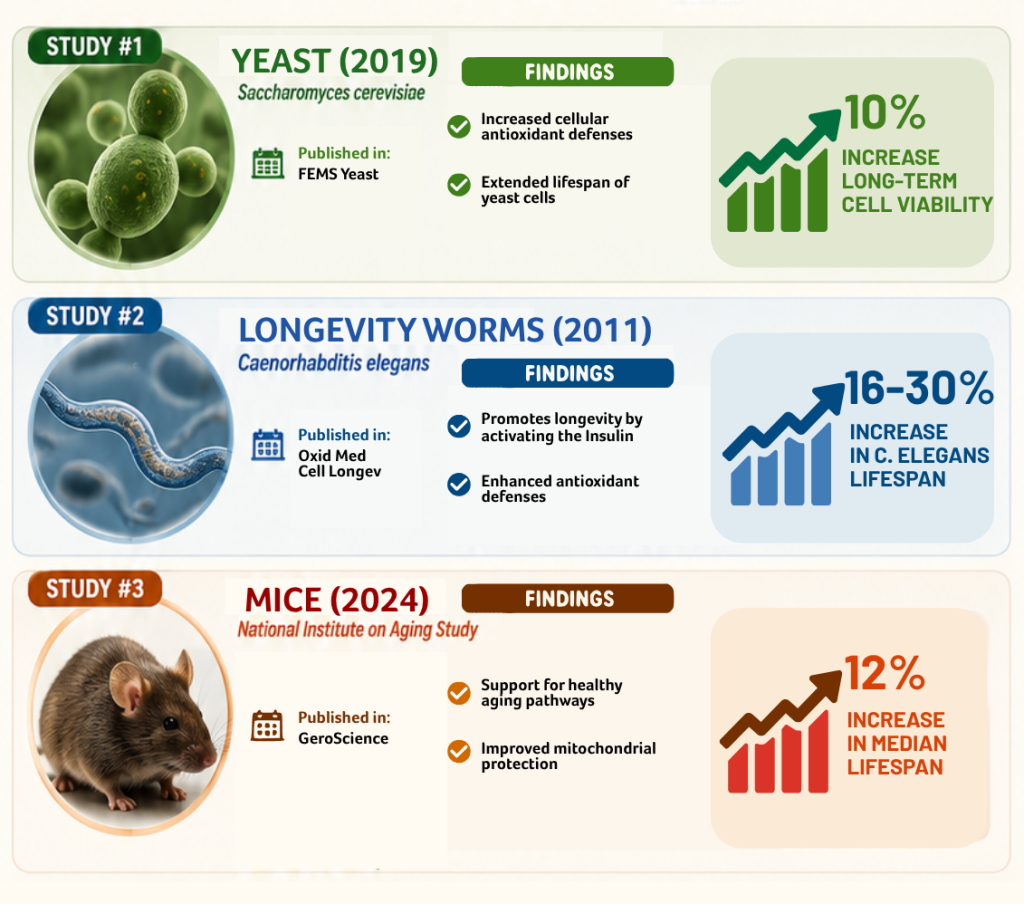
In a 2025 study published in Food & Function 1, researchers found that astaxanthin extended lifespan in Caenorhabditis elegans, a tiny worm commonly used in aging research. The worms not only lived longer, but also showed signs of healthier aging, including improved movement and reduced accumulation of age-related cellular waste. The researchers concluded that astaxanthin supported longevity by improving the body’s antioxidant defences and promoting cellular cleanup processes known as autophagy. Another study published in Oxidative Medicine and Cellular Longevity 2 found that astaxanthin, a natural antioxidant, increased the lifespan of C. elegans worms by 16–30%. The researchers also found that astaxanthin works by activating genes involved in protecting cells from aging, suggesting it may help slow the aging process.
Why is this important?
Autophagy is often described as the body’s natural “recycling system.” It helps remove damaged cellular components so healthier cells can function more efficiently. Many longevity experts consider autophagy one of the most important biological processes associated with healthy aging.
Evidence Beyond Worm Studies
Of course, living longer worms don’t automatically mean humans will live longer.
However, similar findings have been observed in other biological models.
A study published in FEMS Yeast Research 3 found that astaxanthin extended the 10% lifespan of yeast cells by reducing oxidative stress and protecting cells from programmed cell death. Researchers observed lower levels of damaging reactive oxygen species and improvements in cellular defenses 3.
What makes this significant is that scientists have now observed longevity-related benefits across multiple species and experimental models, suggesting that astaxanthin may influence fundamental biological pathways involved in aging.
The Most Exciting Animal Study Yet
Perhaps the most compelling evidence comes from a 2024 study published in GeroScience 4.
Researchers from the National Institute on Aging’s Interventions Testing Program examined astaxanthin in genetically diverse mice. The study found that male mice receiving astaxanthin experienced a 12% increase in median lifespan, making astaxanthin one of the few natural compounds shown to extend lifespan in a rigorous mammalian aging study 4.
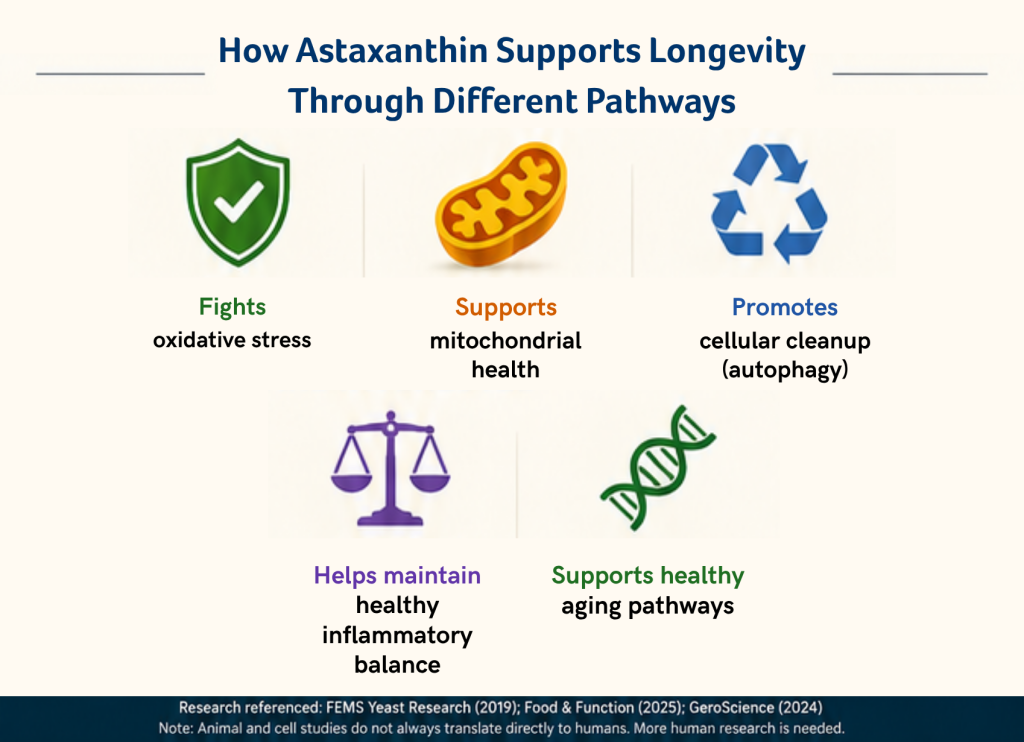
The researchers highlighted several mechanisms that may explain these benefits, including:
- Reduced oxidative stress
- Support for mitochondrial health
- Activation of cellular defence systems
- Support for healthy inflammatory responses
- Regulation of pathways linked to healthy aging and cellular maintenance
While human lifespan studies are obviously not yet available, findings in mammals are generally considered more meaningful than results from simpler organisms alone.
Longevity Is About More Than Living Longer
When most people think about longevity, they focus on lifespan.
But many researchers are increasingly interested in something called healthspan — the number of years spent feeling healthy, active, and independent.
This may be where astaxanthin offers some of its greatest potential.
Research has linked astaxanthin supplementation with support for:
- Healthy energy levels
- Exercise performance and recovery
- Eye comfort and visual health
- Cognitive wellness
- Skin appearance and hydration
- Cardiovascular health
Rather than simply adding years to life, the goal is to add life to those years.
Why More People Are Taking Astaxanthin Daily
Many health-conscious adults now include astaxanthin as part of their daily wellness routine because it is:
- Naturally derived from microalgae
- Well tolerated in human studies
- Backed by decades of antioxidant research
- Supported by emerging longevity science
Unlike trendy ingredients that appear overnight and disappear just as quickly, astaxanthin has been studied extensively for years and continues to gain attention as new research emerges.
The Bottom Line
No supplement can guarantee a longer life.
A healthy diet, regular exercise, quality sleep, stress management, and strong social connections remain the foundations of healthy aging.
However, the scientific evidence surrounding astaxanthin is becoming increasingly difficult to ignore.
Studies in yeast, worms, and most recently mice suggest that astaxanthin may support key biological processes associated with longevity, including antioxidant protection, cellular maintenance, mitochondrial health, and healthy aging pathways.
For those looking to proactively support their long-term health, astaxanthin may be one of the most promising natural ingredients available today.
After all, longevity isn’t just about living longer—it’s about staying healthier for longer. And that’s a goal worth investing in.
References
- Ding, F. & Zhao, Y. Astaxanthin promotes the longevity of Caenorhabditis elegans via modulation of the intracellular redox status and PHA-4-mediated autophagy. Food & function 16, 617–627 (2025).
- Yazaki, K., Yoshikoshi, C., Oshiro, S. & Yanase, S. Supplemental Cellular Protection by a Carotenoid Extends Lifespan via Ins/IGF-1 Signaling inCaenorhabditis elegans. Oxidative Medicine and Cellular Longevity 2011, 1–9 (2011).
- SJ, S., Veerabhadrappa, B., Subramaniyan, S. & Dyavaiah, M. Astaxanthin enhances the longevity of Saccharomyces cerevisiae by decreasing oxidative stress and apoptosis. FEMS Yeast Research (2018) doi:https://doi.org/10.1093/femsyr/foy113.
- Harrison, D. E. et al. Astaxanthin and meclizine extend lifespan in UM-HET3 male mice; fisetin, SG1002 (hydrogen sulfide donor), dimethyl fumarate, mycophenolic acid, and 4-phenylbutyrate do not significantly affect lifespan in either sex at the doses and schedules used. GeroScience (2023) doi:https://doi.org/10.1007/s11357-023-01011-0.