


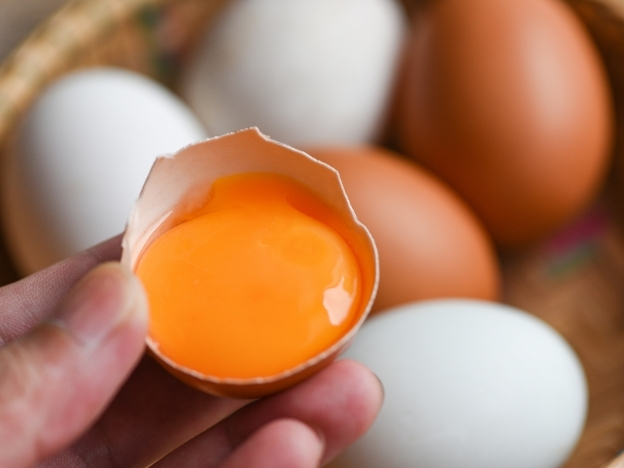
Astaxanthin-enriched eggs combine everyday nutrition with advanced microalgae biotechnology. They are produced by feeding laying hens a carefully formulated diet containing astaxanthin, a naturally red carotenoid commonly derived from the microalga Haematococcus pluvialis.
After the hens consume the enriched feed, astaxanthin is absorbed and naturally transferred into developing egg yolks. This process gives the yolks a deeper orange-red colour while increasing their astaxanthin content.
Research shows that this approach can enrich eggs without significantly changing laying performance or flavour under controlled conditions. The result is a familiar food with added functional value and strong potential for the growing nutrition and wellness market.
What Are Astaxanthin-Enriched Eggs?
Astaxanthin-enriched eggs are produced through nutritional biofortification.
Instead of adding astaxanthin to the egg after it has been laid, producers include the carotenoid in the hens’ diet. The hens digest the supplemented feed, absorb the astaxanthin, and transfer part of it into the yolk during egg formation.
This natural biological process creates an egg that contains measurable astaxanthin within its yolk.
The finished product typically has:
-
A deeper orange-red yolk
-
Naturally deposited astaxanthin
-
A familiar egg flavour
-
A lipid-rich food matrix
-
Potential for functional-food positioning
-
Long-lasting freshness
Astaxanthin-enriched eggs demonstrate how animal nutrition can be used to improve the composition of commonly consumed foods.
Why Is Astaxanthin Used in Laying-Hen Feed?
Astaxanthin is a red carotenoid known for its antioxidant activity. It occurs naturally in microalgae and contributes to the red or pink colour of salmon, trout, shrimp, krill, and other marine organisms.
For poultry applications, astaxanthin serves two important purposes.
First, it is naturally deposited in the egg yolk, creating a richer orange-red appearance.
Second, it increases the astaxanthin content of the yolk, allowing the egg to function as a dietary source of this carotenoid.
A 2025 study published in Poultry Science confirmed that increasing dietary astaxanthin increased astaxanthin deposition in egg yolks. The study also found stronger yolk pigmentation while laying performance and flavour remained largely stable under the tested conditions.[1]
Why Use Haematococcus pluvialis?
Haematococcus pluvialis is one of the richest recognised natural sources of astaxanthin.
Under specific environmental conditions, this microalga accumulates astaxanthin as part of its natural protective response. The red-stage biomass can then be harvested and processed into astaxanthin-rich ingredients for food, nutraceutical, aquaculture, and animal nutrition applications.[2,3]
For astaxanthin-enriched egg production, H. pluvialis offers several advantages:
-
Naturally derived astaxanthin
-
Controlled cultivation
-
Standardised carotenoid content
-
Traceable production
-
Consistent feed formulation
-
Compatibility with functional-food development
The quality of the microalgae ingredient remains essential. Cultivation conditions, harvesting, cell disruption, drying, storage, and analytical testing all influence the consistency of the finished ingredient.
How Are Astaxanthin-Enriched Eggs Produced?
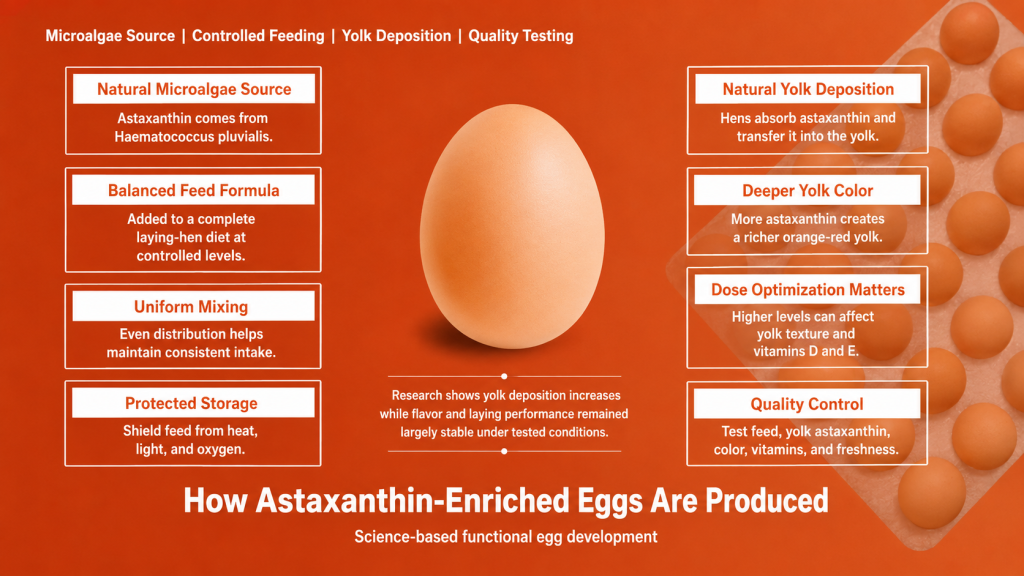
Producing astaxanthin-enriched eggs requires more than adding a coloured ingredient to poultry feed. The process depends on controlled formulation, uniform mixing, consistent feeding, and quality testing.
Selecting a High-Quality Astaxanthin Source
Production begins with a verified astaxanthin ingredient.
For natural astaxanthin eggs, producers can use H. pluvialis biomass or another feed-compatible ingredient derived from the microalga.
Important quality specifications include:
-
Astaxanthin concentration
-
Ingredient identity
-
Carotenoid profile
-
Moisture level
-
Microbiological quality
-
Heavy metal limits
-
Oxidative stability
-
Batch consistency
-
Feed-grade compliance
A standardised ingredient allows producers to calculate the intended feed concentration more accurately and maintain consistent results between production batches.
Creating a Balanced Feed Formula
Astaxanthin is incorporated into a complete laying-hen diet.
The base feed must still provide the protein, energy, amino acids, fatty acids, minerals, and vitamins required for normal egg production. Astaxanthin works as part of this broader nutritional system.
A carefully designed formula supports:
-
Consistent astaxanthin intake
-
Normal laying performance
-
Healthy egg development
-
Stable yolk characteristics
-
Predictable carotenoid deposition
Some production systems also include oils, green forage, postbiotics, or other nutritional ingredients to support digestion and feed quality.
Mixing the Feed Uniformly
Uniform mixing is a critical production step.
Astaxanthin-rich algae is highly concentrated, so it must be distributed evenly throughout the feed. Poor mixing can cause some hens to consume more astaxanthin than others, resulting in inconsistent yolk colour and astaxanthin levels.
Commercial feed manufacturers can use a premixing stage. The concentrated algae ingredient is first blended with a smaller amount of carrier material and then added to the larger feed batch.
Uniform mixing supports:
-
Even daily intake
-
Consistent yolk pigmentation
-
Reliable astaxanthin deposition
-
Better batch-to-batch control
-
More predictable product quality
Protecting Astaxanthin During Storage
Astaxanthin should be protected from excessive heat, light, and oxygen during ingredient and feed storage.[2]
Suitable handling practices can include:
-
Light-resistant packaging
-
Airtight containers
-
Controlled storage temperatures
-
Protection from moisture
-
Appropriate inventory rotation
-
Limited storage after feed preparation
Producers can also test the astaxanthin concentration of the finished feed to confirm that the intended amount remains available throughout the feeding period.
Feeding the Hens Consistently
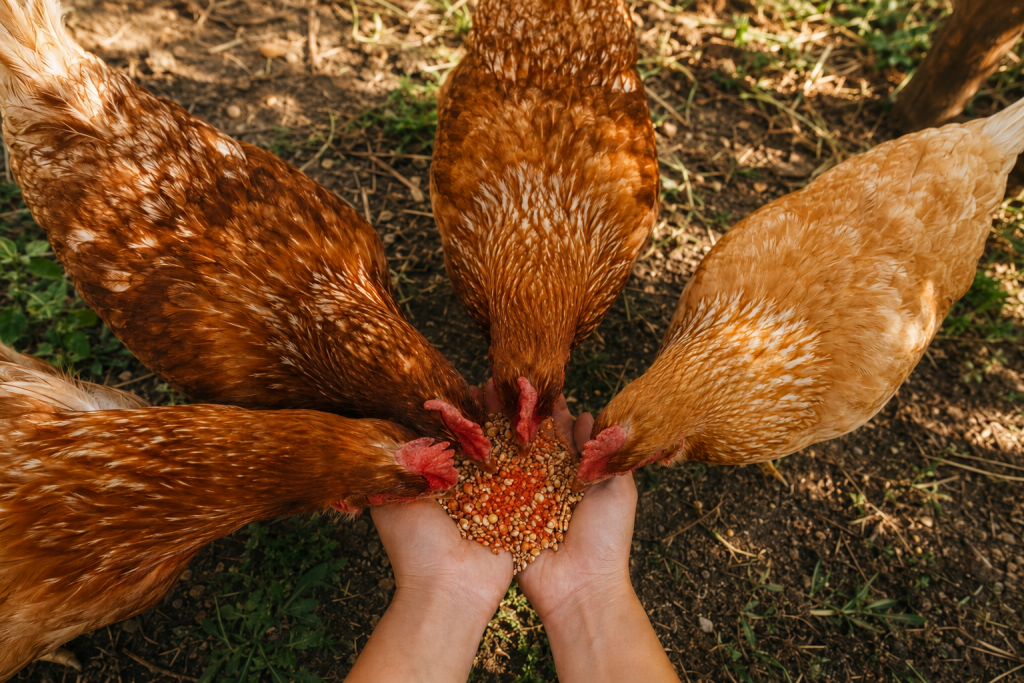
The supplemented feed is provided as part of the hens’ regular daily diet.
Consistent feeding helps stabilise astaxanthin intake and supports uniform deposition into the yolk. Feeding schedules can vary depending on the farm, breed, housing system, production stage, and management practices.
A commercial Chinese production example describes mechanically mixing the feed before delivery and providing several feedings throughout the day. The system is designed to support uniform intake and consistent egg production.[4]
The exact feeding schedule can differ among producers, but the main principle remains the same: stable daily intake supports stable yolk enrichment.
How Does Astaxanthin Reach the Egg Yolk?
After the hen consumes the feed, astaxanthin is released from the feed matrix during digestion.
Because astaxanthin is fat-soluble, it is absorbed together with dietary lipids. It then circulates through the hen’s body in lipid-associated particles.
During egg formation, nutrients are transferred from the bloodstream into developing ovarian follicles. Astaxanthin enters this natural nutrient-delivery pathway and becomes deposited in the yolk.
Egg yolk is naturally rich in:
-
Triglycerides
-
Phospholipids
-
Cholesterol
-
Lipoproteins
-
Fat-soluble vitamins
-
Carotenoids
This makes the yolk a suitable biological carrier for astaxanthin and other lipid-soluble compounds.[5]
The astaxanthin is therefore incorporated into the egg naturally rather than being applied as an external colour.
What Does Research Show About Astaxanthin-Enriched Eggs?
A 2025 Poultry Science study investigated how different levels of dietary astaxanthin affected laying hens and egg yolk composition.[1]
The hens received diets containing:
-
0 percent astaxanthin
-
0.01 percent astaxanthin
-
0.02 percent astaxanthin
-
0.04 percent astaxanthin
The researchers examined laying performance, yolk colour, texture, flavour, fatty acids, amino acids, vitamins, and nutrient-transport pathways.
Astaxanthin Content Increased in the Yolk
The study confirmed that astaxanthin from the diet was transferred into egg yolks.
Higher dietary inclusion produced greater yolk astaxanthin deposition. This provides direct scientific evidence for the production principle behind astaxanthin-enriched eggs.
It also shows that feed formulation can be used to control the amount of astaxanthin delivered into the yolk.
Yolk Colour Became Deeper
As astaxanthin deposition increased, yolk colour became richer and more orange-red.[1]
This deeper colour is one of the most visible characteristics of astaxanthin-enriched eggs. It can also help distinguish the product from conventional eggs.
Professional producers should confirm astaxanthin content through laboratory analysis because several carotenoids can influence yolk appearance.
Laying Performance Remained Stable
The study found no significant change in laying performance under the tested conditions.[1]
This is important for commercial production because it indicates that astaxanthin enrichment can be incorporated into laying-hen diets while maintaining normal productivity.
With appropriate feed design, producers can develop enriched eggs without compromising the basic efficiency of egg production.
Flavour Remained Familiar
Electronic tongue analysis found no significant difference in flavour between the control eggs and the astaxanthin-supplemented eggs.[1]
This finding supports the consumer appeal of astaxanthin-enriched eggs. The yolk can contain more astaxanthin and display a richer colour while preserving the familiar taste expected from an egg.
Practical poultry users have also reported that astaxanthin-rich algae can deepen yolk colour without producing an undesirable taste.[7]
Total Fatty Acid Content Increased at Higher Levels
The study found higher total fatty acid content in the groups receiving 0.02 percent and 0.04 percent astaxanthin.[1]
This suggests that dietary astaxanthin can influence lipid deposition and nutrient transport during yolk formation.
Because egg yolk is naturally lipid-rich, this interaction is relevant to the development of functional eggs and other nutritionally enhanced animal products.
Egg Yolk as a Natural Delivery Matrix
Egg yolk contains lipids and phospholipids that support the digestion of fat-soluble nutrients.
During human digestion, dietary fats contribute to the formation of mixed micelles, which help transport carotenoids through the intestinal environment before absorption.[8]
Human research has shown that eating whole eggs with vegetables can significantly increase the absorption of carotenoids from the same meal.[9]
This supports the broader principle that egg yolk can serve as an effective food matrix for carotenoids.
Astaxanthin-enriched eggs therefore combine the carotenoid with a naturally lipid-rich food, creating a convenient and familiar delivery format.
Why Feed Formulation Matters
Successful astaxanthin enrichment depends on precision.
The objective is to create a high-quality egg with verified astaxanthin content, consistent colour, familiar sensory qualities, and balanced nutrition.
An effective feed-development programme considers:
-
Astaxanthin source
-
Inclusion level
-
Complete feed composition
-
Ingredient stability
-
Mixing uniformity
-
Hen intake
-
Yolk deposition
-
Sensory quality
-
Product testing
Controlled feeding trials allow producers to identify the formulation that delivers the intended astaxanthin concentration and product characteristics.
This science-based approach supports consistency and strengthens consumer confidence.
Quality Control for Astaxanthin-Enriched Eggs
Quality control should begin with the algae ingredient and continue through the finished egg.
Raw-Material Testing
The astaxanthin ingredient can be tested for:
-
Identity
-
Astaxanthin concentration
-
Carotenoid composition
-
Moisture
-
Purity
-
Microbiological quality
-
Heavy metals
-
Oxidative stability
Feed Testing
The completed poultry feed can be evaluated for:
-
Astaxanthin concentration
-
Mixing uniformity
-
Nutritional composition
-
Moisture
-
Stability
-
Microbial quality
-
Contaminants
Egg Testing
Finished eggs can be assessed for:
-
Yolk astaxanthin content
-
Yolk colour
-
Egg weight
-
Shell quality
-
Freshness
-
Fatty acid composition
-
Vitamin content
-
Texture
-
Flavour
-
Microbiological safety
High-performance liquid chromatography can be used to identify and quantify astaxanthin in the yolk.
This provides a reliable analytical measurement and helps producers verify that the finished egg meets its intended specification.
Can Yolk Colour Confirm Astaxanthin Content?
Yolk colour provides a visible indication of carotenoid deposition, but it cannot confirm the exact amount of astaxanthin.
Other pigments that can influence yolk colour include:
-
Lutein
-
Zeaxanthin
-
Canthaxanthin
-
Paprika carotenoids
-
Marigold-derived pigments
-
Other feed ingredients
Two eggs can have similar yolk colours while containing different carotenoid profiles.
For this reason, scientifically developed astaxanthin eggs should be supported by laboratory testing rather than appearance alone.
Verified astaxanthin content provides stronger value than simply promoting a dark yolk.
The Functional-Food Potential of Astaxanthin Eggs
Consumers increasingly seek foods that combine convenience, natural ingredients, and added nutritional value.
Astaxanthin-enriched eggs fit this trend because eggs are already:
-
Widely consumed
-
Nutrient-dense
-
Easy to prepare
-
Familiar to consumers
-
Compatible with many diets
-
Naturally rich in lipids and protein
Adding microalgae-derived astaxanthin creates an opportunity to position eggs within the functional-food market.
Potential product advantages include:
-
Naturally enriched yolks
-
A distinctive orange-red appearance
-
A familiar taste
-
Clear ingredient traceability
-
Science-based nutritional innovation
-
Strong visual differentiation
-
Compatibility with premium food positioning
Astaxanthin-enriched eggs can appeal to consumers interested in natural antioxidants, functional nutrition, microalgae ingredients, and innovative food technologies.
Astaxanthin-enriched eggs demonstrate how microalgae biotechnology can extend beyond capsules and traditional dietary supplements.
Controlled cultivation of H. pluvialis allows manufacturers to produce astaxanthin-rich biomass with a measurable and standardised carotenoid profile.[2,3]
This ingredient can then support applications in:
-
Functional foods
-
Poultry nutrition
-
Aquaculture
-
Nutraceuticals
-
Cosmetics
-
Animal health
-
Feed innovation
The development process brings together multiple areas of expertise:
-
Microalgae cultivation
-
Carotenoid production
-
Cell disruption
-
Ingredient stabilisation
-
Feed formulation
-
Poultry nutrition
-
Analytical testing
-
Functional-food development
Iconthin’s experience in microalgae biotechnology and natural astaxanthin production supports the development of consistent ingredients for advanced nutritional applications.
Astaxanthin-enriched eggs are one example of how natural microalgae compounds can be incorporated into innovative food systems.
Conclusion
Astaxanthin-enriched eggs are produced by feeding laying hens a carefully formulated diet containing astaxanthin, commonly derived from Haematococcus pluvialis.
The hens absorb the carotenoid and naturally transfer it into developing egg yolks. Research confirms that this process can increase yolk astaxanthin content, create a deeper orange-red colour, and preserve stable laying performance and familiar flavour under controlled conditions.[1]
The key to successful production is precision.
A high-quality astaxanthin-enriched egg requires:
-
A verified natural astaxanthin source
-
Balanced poultry nutrition
-
Controlled feed formulation
-
Uniform ingredient mixing
-
Suitable storage
-
Consistent feeding
-
Laboratory analysis
-
Reliable quality standards
When these elements work together, astaxanthin-enriched eggs offer a compelling combination of natural nutrition, microalgae biotechnology, and functional-food innovation.
References
-
Yu AC, Long C, Sheng XH, et al. High dietary astaxanthin supplementation alters egg yolk nutritional composition in hens. Poultry Science. 2025;104(9):105393. doi:10.1016/j.psj.2025.105393.
-
Ambati RR, Phang SM, Ravi S, Aswathanarayana RG. Astaxanthin: sources, extraction, stability, biological activities and its commercial applications. Marine Drugs. 2014;12(1):128-152. doi:10.3390/md12010128.
-
Oslan SNH, Shoparwe NF, Yusoff AH, et al. A review on Haematococcus pluvialis bioprocess optimization of green and red stage culture conditions for the production of natural astaxanthin. Biomolecules. 2021;11(2):256. doi:10.3390/biom11020256.
-
Tianjin Tairuisheng Biotechnology Co., Ltd. How are astaxanthin eggs produced? Chinese-language commercial article. Accessed July 21, 2026.
-
Xiao N, Zhao Y, Yao Y, et al. Biological activities of egg yolk lipids: a review. Journal of Agricultural and Food Chemistry. 2020;68(7):1948-1957. doi:10.1021/acs.jafc.9b06616.
-
Kojima S, Koizumi S, Suzuki H, et al. Effect of dietary carotenoid on egg yolk colour and singlet oxygen quenching activity in laying hens. Journal of Poultry Science. 2022;59(2):137-143.
-
Permies. Organic astaxanthin algae poultry supplement discussion. Online forum post. 2020. Anecdotal source.
-
Reboul E. Mechanisms of carotenoid intestinal absorption: where do we stand? Nutrients. 2019;11(4):838. doi:10.3390/nu11040838.
-
Kim JE, Gordon SL, Ferruzzi MG, Campbell WW. Effects of egg consumption on carotenoid absorption from co-consumed raw vegetables. American Journal of Clinical Nutrition. 2015;102(1):75-83. doi:10.3945/ajcn.115.111062.