


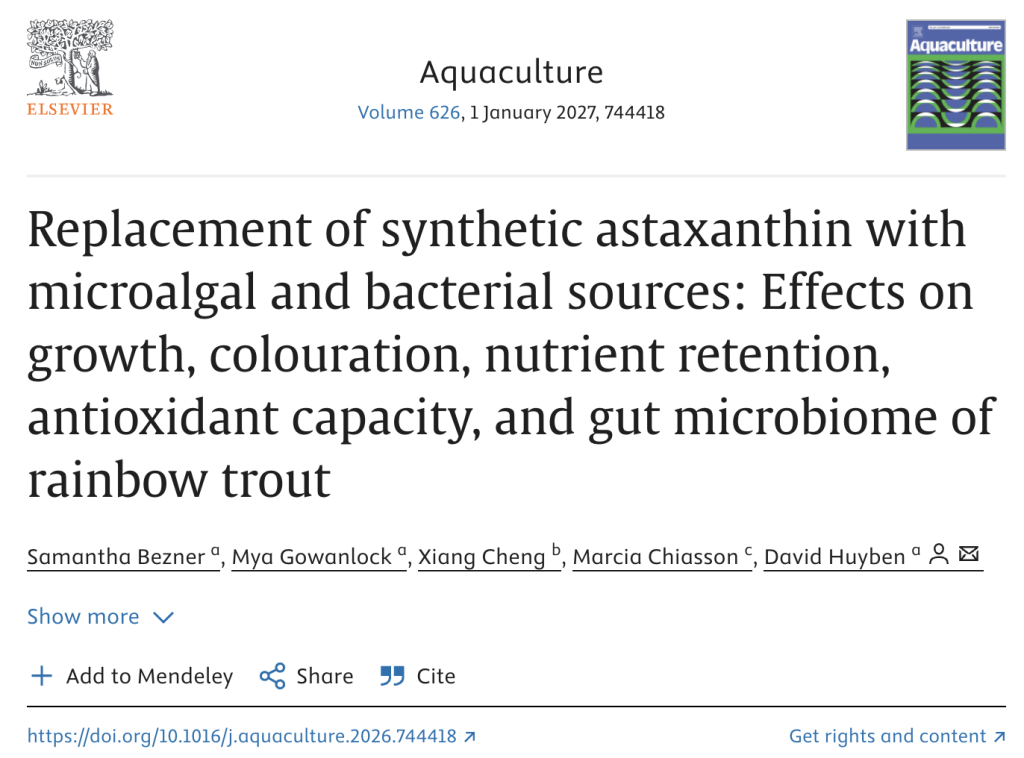
TORONTO, Ontario — August 2026 — Iconthin Biotech Corp., a Canadian biotechnology company specializing in microalgae innovation, announced the publication of a new peer-reviewed study in Elsevier’s Aquaculture evaluating AlgaeAsta® natural astaxanthin ingredients in rainbow trout feed.
The publication marks an important scientific milestone for AlgaeAsta® and supports Iconthin Biotech’s long-term strategy of advancing microalgae technology to produce traceable, renewable and scalable bio-based ingredients for aquaculture and other industries.
Evaluating Natural Astaxanthin in Aquafeed
The study examined microalgae-derived and bacterial astaxanthin sources as potential alternatives to synthetic astaxanthin in rainbow trout diets. Researchers evaluated two AlgaeAsta® ingredients derived from Haematococcus pluvialis, one of the richest natural sources of astaxanthin:
-
AlgaeAsta® Wall-Broken Haematococcus pluvialis, containing 1% natural astaxanthin
-
AlgaeAsta® Astaxanthin Oil, containing 10% natural astaxanthin
The research assessed several indicators relevant to aquaculture production, including growth performance, fillet colouration, nutrient retention, antioxidant capacity and gut microbiome composition.
The study found that astaxanthin accumulation was highest in rainbow trout fed microalgal and synthetic astaxanthin diets. The microalgal powder also influenced gut microbial communities, indicating that the source and formulation of astaxanthin may have effects extending beyond pigmentation.
These findings add to the scientific understanding of microalgae-derived astaxanthin and its potential role in modern aquafeed formulation.
“This publication is an important milestone for AlgaeAsta® and natural astaxanthin research in Canada,” said Dr. Alvin Cheng, founder and CEO of Iconthin Biotech. “It strengthens the scientific foundation for developing more sustainable, microalgae-based alternatives for aquaculture feed and demonstrates the value of evaluating natural ingredients under controlled aquaculture conditions.”
Astaxanthin is a naturally occurring red carotenoid and antioxidant widely used in feed for salmonids, including salmon and rainbow trout. Because these fish cannot produce astaxanthin on their own, it must be supplied through their diets to support their characteristic flesh colouration.
Synthetic astaxanthin currently accounts for much of the astaxanthin used in commercial aquafeed. However, growing demand for traceable, naturally derived and renewable ingredients is accelerating interest in astaxanthin produced from microalgae.
The rigid cell wall of Haematococcus pluvialis can limit access to the astaxanthin accumulated within the microalgal cells. AlgaeAsta® Wall-Broken H. pluvialis is processed to improve accessibility, while AlgaeAsta® Astaxanthin Oil provides natural astaxanthin in a concentrated oil-based format for aquafeed and animal nutrition applications.
Iconthin Biotech is continuing to advance its microalgae cultivation and processing technologies to improve production efficiency and help reduce the cost of natural astaxanthin. These developments are intended to make microalgae-derived alternatives more commercially accessible at scale.
Beyond astaxanthin, the company is developing microalgae as a biological production platform for renewable ingredients across food, feed, dietary supplements, cosmetics and personal care.
“Our work extends beyond a single ingredient,” Dr. Cheng added. “By improving the way microalgae are cultivated and processed, we aim to unlock a broader range of high-value natural compounds and make bio-based alternatives more competitive with synthetic products.”
The publication follows another significant milestone for AlgaeAsta®. In 2026, the Canadian Food Inspection Agency cleared AlgaeAsta® microalgae-based astaxanthin for animal feed applications in Canada.
Together, peer-reviewed research and regulatory clearance strengthen the foundation for the continued commercialization and broader adoption of natural astaxanthin in aquaculture and animal nutrition.
The study was conducted in collaboration with researchers at the University of Guelph, including Samantha Bezner, Mya Gowanlock, Xiang Cheng, Marcia Chiasson and David Huyben, with support from Mitacs.
The complete study, “Replacement of synthetic astaxanthin with microalgal and bacterial sources: Effects on growth, colouration, nutrient retention, antioxidant capacity, and gut microbiome of rainbow trout,” is published in Aquaculture, Volume 626, Article 744418.
DOI: 10.1016/j.aquaculture.2026.744418
Research: https://www.sciencedirect.com/science/article/pii/S004484862600801X
AlgaeAsta®: https://iconthin.com/algaeasta-astaxanthin/
