


Are you and your partner facing the heart-wrenching challenge of infertility? The journey to starting a family can be filled with uncertainties and emotional ups and downs. But here’s some exciting news that might lift your spirits! Recent scientific studies have unearthed the potential of a remarkable natural compound called astaxanthin (AST), which is commonly found in seafood and microorganisms. Astaxanthin is emerging as a promising ally in the quest for enhanced fertility outcomes in both men and women.
Have you ever wondered how astaxanthin could improve male fertility? Many couples struggle with low sperm quality, reduced sperm count, or sluggish swim velocity. But the results from clinical studies are raising hope. Astaxanthin has shown the potential to enhance sperm parameters, such as sperm count, motility, and morphology, leading to improved chances of fertilization. Could astaxanthin be the missing link to improving your chances of conceiving?
As we delve into the fascinating world of astaxanthin and its potential to enhance fertility, we’ll address common questions that arise in the minds of couples like you. How does astaxanthin actually work to improve fertility? Are there any side effects to consider? Can astaxanthin benefit both partners simultaneously? We’ll explore these intriguing questions and more, equipping you with the knowledge you need to make informed decisions on your path to parenthood.
Astaxanthin for Men: Boosting Sperm Health
Are you and your partner struggling to conceive? Well, there’s exciting news that might bring a ray of hope. Recent scientific studies have revealed the potential of AST, a natural compound found in seafood and microorganisms, in improving fertility outcomes, especially in men. Let’s dive into one remarkable study that provides compelling evidence of how AST can boost sperm health and increase the chances of successful conception.
In a groundbreaking clinical trial (Comhaire F.H. et al., 2005), researchers conducted a double-blind, randomized study involving 30 men with infertility. These men had been trying to conceive for at least two months, and their female partners had no apparent cause of infertility. The participants received conventional treatment as recommended by the World Health Organization (WHO), along with either a daily dose of 16mg of astaxanthin or a placebo for three months.
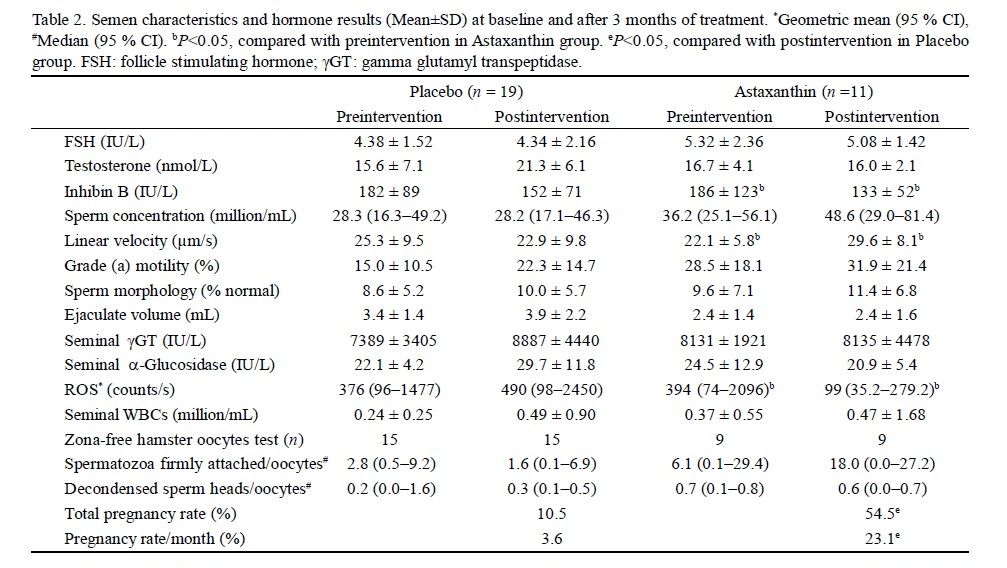
The results were truly remarkable. The group receiving astaxanthin experienced significant improvements in sperm health compared to the placebo group. Here’s what they found:
- Improved Sperm Parameters: Sperm motility, which refers to the ability of sperm to move effectively, increased in the astaxanthin group. This improvement in sperm linear velocity suggests that astaxanthin enhances the movement and swimming ability of sperm, increasing their chances of reaching and fertilizing an egg successfully.
- Reduced Oxidative Stress: Reactive oxygen species (ROS), which are harmful molecules that can damage sperm, decreased significantly in the astaxanthin group. This reduction in oxidative stress indicates that astaxanthin acts as a powerful antioxidant, protecting sperm from damage and improving their functional capacity.
- Hormone Balance: Levels of Inhibin B hormone, which is closely associated with male fertility, decreased significantly in the astaxanthin group. This finding suggests that astaxanthin supplementation may help balance hormone levels, promoting optimal reproductive function in men.
- Increased Pregnancy Rates: The most exciting outcome of the study was the significant difference in pregnancy rates between the two groups. The astaxanthin group achieved a pregnancy rate of 54.5%, with a monthly probability of conception of 23.1%. In contrast, the placebo group had a pregnancy rate of only 10.5%, with a monthly probability of pregnancy of 3.6%. These results clearly indicate that astaxanthin supplementation can substantially increase the chances of successful conception.
While these findings are incredibly promising, it’s important to note that further research is needed to confirm these results in larger trials. Nevertheless, the potential benefits of astaxanthin in improving sperm health and fertility cannot be overlooked.
Astaxanthin for Women: Nurturing Reproductive Wellness
For women facing challenges in the journey to motherhood, astaxanthin brings a glimmer of hope. Do you dream of increasing your pregnancy rate or improving the quality of your embryos? Studies have revealed that astaxanthin supplementation may positively impact reproductive outcomes by increasing the number of high-quality oocytes, improving embryo quality, and supporting successful implantation. If you’ve been struggling with unsuccessful IVF attempts or lack of high-quality embryos, astaxanthin might hold the key to turning the tide in your favor.
In studies involving women with conditions like polycystic ovarian syndrome (PCOS) and endometriosis, AST supplementation consistently showed positive effects on reproductive health. By enhancing antioxidant status, AST helps protect cells from oxidative stress, a key factor in fertility. It also improves the quality of oocytes and embryos, increasing the chances of successful assisted reproductive technology (ART) procedures.
In the study titled “Randomized controlled trial of astaxanthin impacts on antioxidant status and assisted reproductive technology outcomes in women with polycystic ovarian syndrome” conducted by Gharaei et al. in 2022. It focused on the effects of astaxanthin on antioxidant status and assisted reproductive technology outcomes in women with PCOS. The study included 42 women with PCOS who were randomly assigned to receive either 8mg/day of astaxanthin or a placebo for 40 days. The results showed that astaxanthin supplementation significantly increased serum levels of total antioxidant capacity (TAC) and catalase (CAT), indicating improved antioxidant status. Additionally, gene expression analysis revealed an upregulation of Nrf2, a key regulator of antioxidant defenses, and its downstream targets HO-1 and NQ1. This suggests that astaxanthin activates the Nrf2 antioxidant pathway, further enhancing the antioxidant response. In terms of ART outcomes, the study found that women who received astaxanthin had a significantly higher rate of mature oocytes (MII) and high-quality embryos. These findings indicate that astaxanthin can improve oocyte and embryo quality in women with PCOS, potentially enhancing the success of ART procedures.
Another clinical trial titled “Astaxanthin treatment ameliorates ER stress in polycystic ovary syndrome patients: a randomized clinical trial,” conducted by Jabarpour et al. in 2023, explored the impact of astaxanthin treatment on endoplasmic reticulum (ER) stress in PCOS patients.The study included 53 female PCOS patients who were randomly assigned to receive either 12mg/day of astaxanthin or a placebo for 60 days. The results revealed that astaxanthin supplementation led to a reduction in the expression levels of ER stress-related genes, including CHOP, GRP78, and XBP1, while ATF4 expression increased. This indicates that astaxanthin can modulate ER stress in granulosa cells of PCOS patients, potentially alleviating this stress. Furthermore, astaxanthin supplementation increased the total antioxidant capacity (TAC) level in the follicular fluid, contributing to improved antioxidant status. Although there were no significant differences in the number of retrieved oocytes, embryos, and fertilization rates, the astaxanthin group had a higher proportion of mature (MII) and high-quality oocytes. These findings suggest that astaxanthin treatment can positively impact oocyte and embryo quality in PCOS patients.

We’ve already discussed how astaxanthin supplementation can benefit women with polycystic ovarian syndrome (PCOS). But did you know that it may also offer promising results for women with endometriosis?
The randomized, triple-blind placebo-controlled clinical trial titled ” Astaxanthin ameliorates inflammation, oxidative stress, and reproductive outcomes in endometriosis patients undergoing assisted reproduction: A randomized, triple-blind placebo-controlled clinical trial” published in 2023, aimed to evaluate the effects of astaxanthin on inflammation, oxidative stress, and reproductive outcomes in 50 women with endometriosis undergoing assisted reproduction. The results revealed some exciting insights:
First, let’s talk about inflammation and oxidative stress. After 12 weeks of astaxanthin treatment, the women in the astaxanthin group experienced a significant decrease in pro-inflammatory cytokines, including IL-1β and TNF-α. This indicates that astaxanthin can help reduce inflammation in endometriosis patients. Additionally, astaxanthin supplementation led to an increase in serum levels of total antioxidant capacity (TAC) and superoxide dismutase (SOD), suggesting improved antioxidant status. Moreover, the levels of malondialdehyde (MDA), a marker of oxidative stress, significantly decreased. These results collectively demonstrate the potential of astaxanthin in alleviating inflammation and oxidative stress associated with endometriosis.
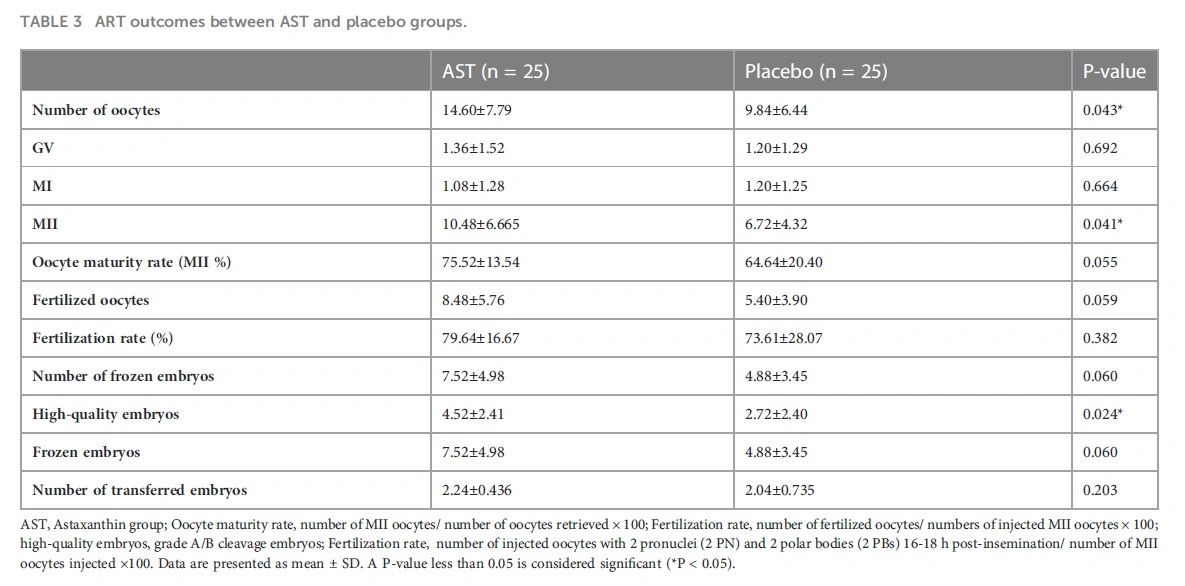
Now, let’s move on to the reproductive outcomes. The study found that women who received astaxanthin had a higher number of oocytes retrieved compared to the placebo group. Furthermore, the astaxanthin group had a greater number of mature (MII) oocytes and high-quality embryos. These findings indicate that astaxanthin supplementation may improve certain aspects of assisted reproduction in endometriosis patients, potentially increasing the chances of successful outcomes.
By combining these quantitative results, we see a comprehensive picture of how AST can positively impact women struggling with infertility. Its ability to enhance antioxidant status means better protection against oxidative damage, while improved oocyte and embryo quality significantly increase the likelihood of successful pregnancy. Moreover, the reduction in inflammation and stress contributes to a more favorable reproductive environment.
It’s important to mention that while the majority of clinical studies have shown positive effects of astaxanthin on fertility, there is one study (Kumalic SI et al., 2020) that did not observe significant improvements. In a randomized double-blind placebo-controlled trial with men diagnosed with oligo-astheno-teratozoospermia (O±A±T), astaxanthin supplementation did not demonstrate any significant impact on semen parameters over a three-month treatment period. The study highlighted that the placebo group experienced a significant increase in total sperm count and concentration, while the astaxanthin group did not show significant changes. This suggests that astaxanthin supplementation may not improve semen parameters in men with this particular condition. It’s important to note that each individual’s response to supplementation can vary, and further research is needed to fully understand the effects of astaxanthin in different populations.
The exciting findings from these studies shed light on the potential of astaxanthin to enhance fertility in both men and women. For men, astaxanthin can boost sperm health, improving motility, count, and morphology. For women, astaxanthin promotes reproductive wellness by enhancing antioxidant capacity, reducing inflammation, and improving oocyte and embryo quality. While these results are promising, it’s crucial to consult with a healthcare professional before embarking on any supplementation regimen. With further research, astaxanthin may offer hope and become a go-to natural solution for couples seeking to overcome fertility challenges and embrace the joy of parenthood.
Reference
- Comhaire FH, El Garem Y, Mahmoud A, Eertmans F, Schoonjans F. Combined conventional/antioxidant “Astaxanthin” treatment for male infertility: a double blind, randomized trial. Asian J Androl. 2005 Sep;7(3):257-62. doi: 10.1111/j.1745-7262.2005.00047.x. PMID: 16110353.
- Gharaei R, Alyasin A, Mahdavinezhad F, Samadian E, Ashrafnezhad Z, Amidi F. Randomized controlled trial of astaxanthin impacts on antioxidant status and assisted reproductive technology outcomes in women with polycystic ovarian syndrome. J Assist Reprod Genet. 2022 Apr;39(4):995-1008. doi: 10.1007/s10815-022-02432-0. Epub 2022 Mar 3. PMID: 35237893; PMCID: PMC9050983.
- Jabarpour M, Aleyasin A, Nashtaei MS, Lotfi S, Amidi F. Astaxanthin treatment ameliorates ER stress in polycystic ovary syndrome patients: a randomized clinical trial. Sci Rep. 2023 Feb 28;13(1):3376. doi: 10.1038/s41598-023-28956-8. PMID: 36854788; PMCID: PMC9974957.
- Rostami S, Alyasin A, Saedi M, Nekoonam S, Khodarahmian M, Moeini A, Amidi F. Astaxanthin ameliorates inflammation, oxidative stress, and reproductive outcomes in endometriosis patients undergoing assisted reproduction: A randomized, triple-blind placebo-controlled clinical trial. Front Endocrinol (Lausanne). 2023 Mar 20;14:1144323. doi: 10.3389/fendo.2023.1144323. PMID: 37020589; PMCID: PMC10067663.
- Kumalic SI, Klun IV, Bokal EV, Pinter B. Effect of the oral intake of astaxanthin on semen parameters in patients with oligo-astheno-teratozoospermia: a randomized double-blind placebo-controlled trial. Radiol Oncol. 2020 Oct 23;55(1):97-105. doi: 10.2478/raon-2020-0062. PMID: 33885235; PMCID: PMC7877271.
