


Introduction
Astaxanthin, a potent antioxidant derived primarily from the microalgae Haematococcus pluvialis, has been associated with various health benefits. While we’ve previously introduced astaxanthin and its potential benefits, in this series we aim to dive into the human clinical trials that have been conducted to substantiate these claims.

Purpose of This Blog Series
This blog series will dissect all available human clinical trials on astaxanthin, published on PubMed, answering your most frequently asked questions about its potential health benefits. Our goal is to provide you with evidence-based health information, derived directly from the scientific studies.
Why Clinical Trials Matter
Clinical trials, being the gold standard in supplement research and drug discovery, are vital in our journey to explore substances like astaxanthin. The journey to human clinical trials commences with cellular studies, which help us comprehend a molecule’s interaction with cells. Following this, animal studies provide insights into the substance’s behavior in a complex biological system and its potential side effects.
However, it’s human clinical trials that offer the most reliable and comprehensive data. These trials, conducted on human volunteers in a controlled setting, enable us to evaluate the substance’s safety and efficacy in humans with a high degree of accuracy. Thus, they are fundamental to confirming the health benefits claimed from previous studies, and ultimately, for gaining regulatory approval for human consumption.
In this series of blogs, we’ll delve into the world of clinical trials and their significance, specifically focusing on astaxanthin. Through this lens, we’ll see how scientific evidence forms the backbone of our understanding and utilization of this potent molecule.
In the era of abundant information, understanding the significance of clinical trials becomes even more crucial. The next time you come across a new health supplement or a promising molecule, remember to check for its clinical trials. After all, they are the gold standard for a reason.
Overview of Existing Trials
We located a total of 60 human clinical trials on astaxanthin on PubMed. These trials span from the first one conducted in 2003, demonstrating the safety of astaxanthin derived from Haematococcus pluvialis, to the most recent ones published in April 2023. Intriguingly, there is a growing body of promising results from these trials, particularly in areas such as vision, cognitive function, fertility, skin health, and cholesterol control. Notably, most of these breakthroughs have emerged in the last two years, reflecting the rapidly expanding interest in astaxanthin research.
Screening Process
We applied two criteria to screen these studies:
- Trials where astaxanthin was not directly applied to humans were excluded. For example, a study in 2008 fed synthetic astaxanthin to salmon, which was then fed to humans. While interesting, the additional factors involved in this study could potentially skew the effects of astaxanthin.
- Trials where astaxanthin was a minor component (less than 1mg/day) of a complex containing multiple ingredients (more than 4) were also excluded. In these cases, it would be difficult to attribute any observed effects solely to astaxanthin.
After this rigorous screening, 51 clinical trials remained. These trials form our astaxanthin human clinical study database, which we will refer to throughout this blog series.
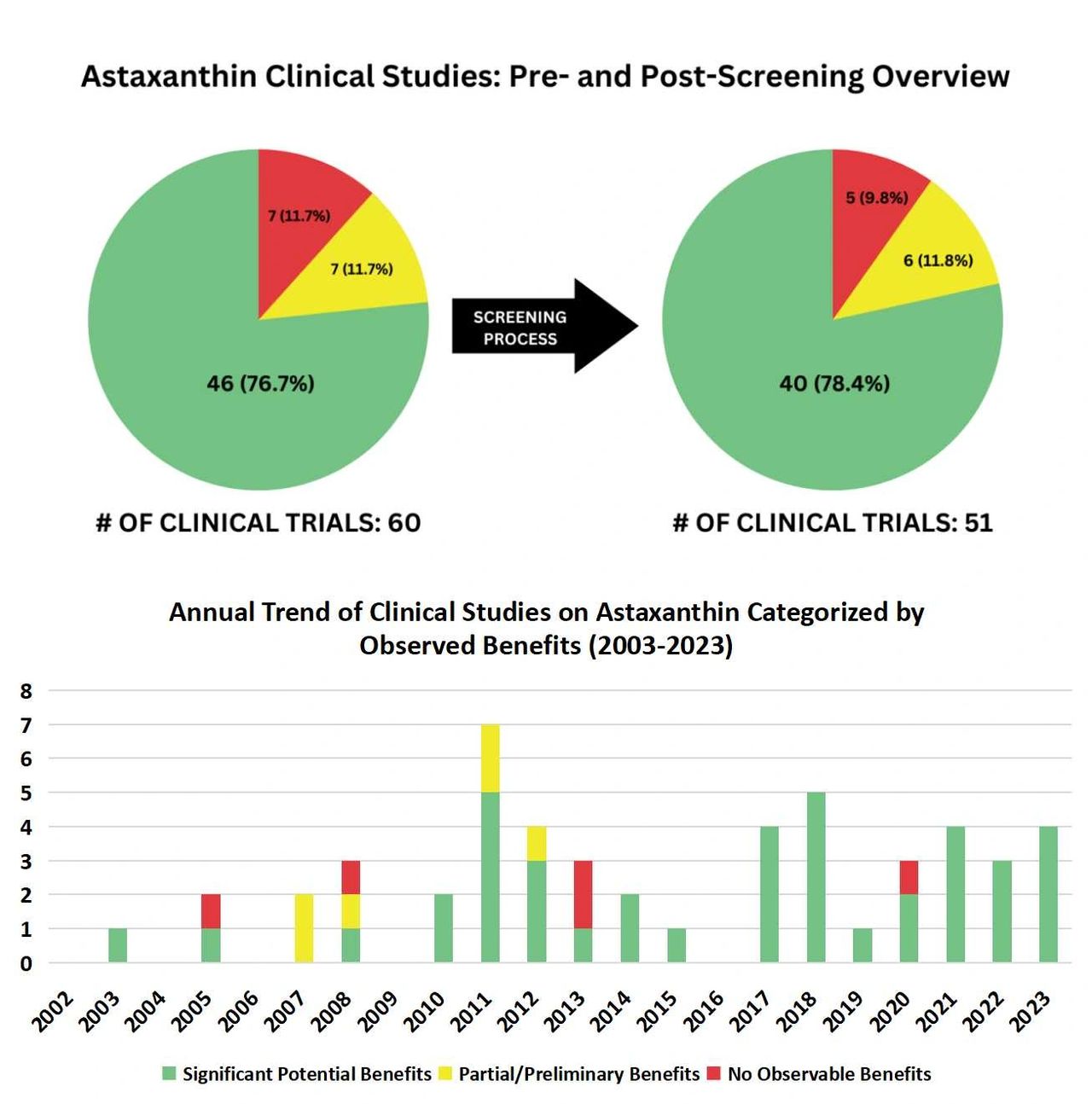
This infographic provides a snapshot of the current research landscape, showing the promising potential of astaxanthin as indicated by a significant number of trials.
Out of these 51 trials, two involved topical application of astaxanthin, while the others involved oral intake. 36 trials studied the effects of astaxanthin alone, and 15 studied the effects of a complex containing astaxanthin.
Insights from Filtered-Out Studies
Some filtered-out studies, while not fitting our criteria for inclusion, still provided intriguing findings worth highlighting.
For instance, a 2008 study feeding salmon (rich in astaxanthin) to humans for 28 days showed a preference for the absorption of the levo-astaxanthin ((3R,3’R) form) in human plasma. This suggests an interesting selective absorption process in the human body.
A 2010 study using a synthetic astaxanthin derivative, Xancor, showed no impact on platelet, coagulation, or fibrinolytic indices. The non-effect could be due to the synthetic nature of the astaxanthin used or an invalidation of the hypothesis that the drug could affect these parameters.
In 2018, a study involving the consumption of krill oil powder, naturally containing astaxanthin, by overweight subjects showed no significant changes in hematology variables, blood pressure, or lipid values. The lack of effect could be due to multiple factors, including a potentially incorrect hypothesis or the small amount of naturally occurring astaxanthin in krill oil.
Three studies using a branded complex, “Armolipid Plus” containing six ingredients with only 0.5mg of astaxanthin, were also filtered out. Despite promising results in lowering total cholesterol and low-density lipoprotein cholesterol, we excluded them due to the difficulty in determining the contribution of astaxanthin to these effects.
These findings from the filtered-out studies illustrate the complexity and diversity of the research landscape surrounding astaxanthin, underscoring the importance of continued investigation.
Preview of Upcoming Blogs
In our upcoming blogs, we will be exploring various health benefits of astaxanthin as suggested by clinical trials. Each blog will focus on a different aspect and answer popular questions we’ve encountered:
- Vision Health: “Can astaxanthin improve my eyesight or prevent age-related macular degeneration?”
- Skin Health: “How does astaxanthin contribute to skin health? Can it help with wrinkles or skin hydration?”
- Fertility: “Can astaxanthin boost male fertility? What about its effects on women’s reproductive health?”
- Cognitive Health: “Does astaxanthin have any benefits for brain health? Can it prevent or slow cognitive decline?”
- Inflammation and Antioxidant Effects: “Is astaxanthin a powerful antioxidant? Can it help reduce inflammation in my body?”
- Women’s Health: “Are there specific benefits of astaxanthin for women, perhaps in relation to menopause or hormonal balance?”
- Athletic Performance: “Can astaxanthin enhance my athletic performance or aid in recovery post-exercise?”
- Other Interesting Health Benefits: “Are there other lesser-known benefits of astaxanthin, such as vocal fold protection or improving sleep efficiency?”
We hope that by addressing these questions, we can provide you with a comprehensive understanding of astaxanthin’s potential benefits backed by scientific evidence.
Join Our Research Initiative
If you’re a researcher, engineer, or doctor interested in performing studies on astaxanthin, we’re keen on collaborating and providing related materials. Please reach out to us, and together, we can further our understanding and bring the benefits of astaxanthin to more people.

A Note on Our Categorization
Please note, the three categories we’ve used to classify the results of these studies—No Observable Benefits, Partial or Preliminary Benefits, and Significant Potential Benefits—are simply a tool to help visualize the big picture of astaxanthin research.
However, it’s important to understand that this classification is not meant to present a quantitative analysis. The categorization is somewhat subjective, largely depending on the specific hypothesis set in each individual study.
For instance, similar results could land a study in the ‘No Observable Benefits’ category or the ‘Partial or Preliminary Benefits’ category, depending on the study’s specific objectives and expectations. This is why we encourage readers to delve deeper into each study with us as we move forward in this blog series, providing context and analysis that brings clarity to these categorizations.
In essence, this division is a starting point for discussion, an invitation to a more in-depth exploration of each study, and a commitment to a nuanced understanding of astaxanthin’s potential benefits. It’s a journey of discovery that we’re excited to embark on together with you.